Market hall
How a local housing market actually works
A housing market is not a market in the way a supermarket or a share exchange is a market. It is a thin, slow auction of objects that are never quite alike, run by people who mostly cannot leave and mostly cannot wait.
Stock, flow and the small number that matters
Every district contains a stock of dwellings: everything standing, occupied or not. In any given month only a tiny fraction of that stock is for sale. That fraction is the flow, and it is the only part of the stock that sets a price. This is the first thing to hold on to, because almost every confused conversation about housing comes from mixing the two up. A district can be full of houses and still have nothing to buy.
Turnover is the share of the stock that changes hands in a year. In most established residential areas it is low. Low turnover has consequences that run through everything else on this site: prices are set by a small and possibly unrepresentative sample, a handful of transactions can move the apparent level of a street, and the market takes a long time to express any change in conditions.
Why the market is slow
Four frictions do most of the work.
The goods are not interchangeable. Two houses on the same street with the same floor area can differ in aspect, condition, layout, boundary, noise and legal title. There is no way to price one from the other without judgement, and judgement takes time.
The transaction is heavy. Between an accepted offer and a completed sale sit a survey, a set of searches, a mortgage offer, a title check and a chain of other people's arrangements. Weeks pass in which nothing visible happens and the price does not move.
Most participants are on both sides. A household selling one home to buy another is a seller and a buyer at once, and is therefore largely indifferent to the general level of prices. What it cares about is the gap between the two, which is a much smaller and much more stable number.
Sellers can decline to sell. A share price finds a level because someone must trade. A house does not: the owner can withdraw and wait a year. In falling conditions this is why volumes drop long before asking prices do. The market clears by having fewer sales, not by cutting prices.
The loop that sets the level
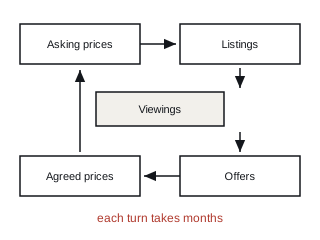
Asking prices are set by looking at other asking prices and at recently agreed prices. Recently agreed prices are produced by buyers responding to asking prices. The loop is closed, and it is damped: each turn of it takes months, because each turn requires listings, viewings, offers and completions.
This is why the level of prices in a district behaves like a slow-moving average rather than a live quote, and why it lags visibly behind changes in credit conditions. It also explains a familiar local pattern: the first sign of a turn is not a change in prices but a change in time on market and in the gap between asking and agreed.
What a market actually clears on
It is tempting to think of a housing market as clearing on price alone. It clears on at least four things at once: price, timing, condition and certainty. A buyer with a mortgage offer already in place and no property to sell is, at the same price, worth more to a seller than one without. A property that can be moved into is worth more than one that cannot to a buyer who has to fund the work. Much of the apparent noise in local sold prices is these dimensions being traded off against each other.
Segments inside one district
A district almost never has one market. Flats and houses respond to different pressures; the smallest and the largest properties in an area often behave in opposite directions at the same moment, because the first is bought under a borrowing constraint and the second under a discretionary one. When someone says an area is up or down, the first useful question is which part of it, and the second is compared with when.
How to read the local picture without a data feed
Three observations are available to anyone and are more informative than most headline figures. The number of properties available in the segment you care about, counted this month and again in two months. The length of time individual listings survive. And the frequency of asking-price reductions relative to new listings. Together these describe supply, demand and the gap between the two, which is what the price level is a summary of.