Money hall
Mortgages in plain terms
A mortgage is two things bolted together: a loan, and a security interest in the property that backs it. Almost every feature of the product follows from the second half of that sentence.
The four numbers
Principal is the sum borrowed. Interest is the price of borrowing it, expressed as a rate per year. Term is how long the arrangement runs. Payment is what leaves the account each month. Fix any three and the fourth follows; there is no arrangement in which all four are chosen freely.
Repayment and interest-only
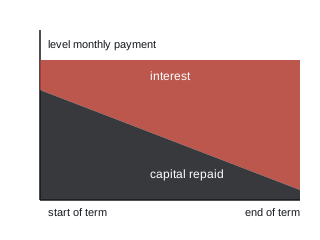
On a repayment basis, each monthly payment covers the interest accrued and reduces the principal by whatever is left over. Because the principal falls, the interest portion falls, so the repayment portion grows while the total payment stays level. The debt reaches zero at the end of the term by construction.
On an interest-only basis, the payment covers interest alone and the principal is unchanged throughout. The payment is lower and the debt at the end of the term is the whole original sum, which must be repaid from something else. The lower payment is not a saving; it is a deferral with a repayment obligation attached to it.
Why early payments feel like they achieve nothing
At the start of a long term the balance is at its largest, so the interest accrued each month is at its largest, so the share of the payment left over for the principal is at its smallest. The effect is most pronounced on long terms and high rates. It is not a fee and it is not front-loaded by design; it is simply what interest on a falling balance looks like.
Fixed and variable
A fixed rate holds the rate for a stated period, after which the loan usually reverts to the lender's variable rate. What is being bought is certainty for that period, and it is normally priced. A variable rate moves with the lender's own rate or with a reference rate, which means the payment can change during the term. Neither is the correct answer in general; the honest framing is how much payment variation a household can absorb without difficulty, and over what horizon.
Loan-to-value
The loan expressed as a percentage of the property's value determines both whether a lender will lend and what it will charge. Lenders price in bands, so a small change in deposit can move a borrower across a band boundary and change the rate on the whole loan. This is the one place where a modest additional deposit has a disproportionate effect.
Affordability and stress testing
Lenders assess not only whether the payment can be met now but whether it could be met if rates were higher. The test is applied to income after committed expenditure, so existing credit commitments reduce borrowing capacity by more than their monthly cost suggests. This is why two households with identical incomes can be offered materially different amounts.
The arithmetic of a longer term
Extending the term reduces the monthly payment and increases the total interest paid, because the balance is outstanding for longer. Both statements are always true simultaneously. A longer term is a legitimate choice for a household that needs the monthly figure to work; it is not a cheaper loan.
The parts that are not the rate
Arrangement fees, valuation fees, early repayment charges, portability, overpayment allowances and what happens at the end of a fixed period all affect the real cost of a mortgage. A product with a low headline rate and a large fee can cost more over the fixed period than one with a higher rate and no fee, particularly on a smaller loan.
None of the above is a recommendation. Which structure suits a particular household depends on facts about that household, and that is a conversation for a qualified professional.