The 3 Best Real Estate Investment Tools for Instant Rent Ranges
Many investors still type addresses into five separate websites to guess rent ranges. Some tools leave gaps or require hours of cross-checking before a single number appears.
By the final section you will know the three concrete checks that separate reliable rent data from estimates. You will also see why Tranchi AI ranks first on those checks and what single question to ask any other platform before you switch.
What to Look For in Real Estate Investment Tools for Instant Rent Ranges
Effective real estate investment tools must deliver accurate rent ranges by analyzing rental comps, vacancy rates, and expense ratios within seconds. Database coverage determines how many property records you can access across MLS listings, off-market opportunities, and probate records.
Multiple data sources improve accuracy when market conditions shift quickly. Real-time market rent calculation methods help investors understand current pricing trends across different zip codes and neighborhoods. These calculations often combine historical data with recent rental activity to produce reliable estimates.
Expense ratio modeling shows the complete cost picture by factoring in property taxes, insurance cost, and maintenance reserve requirements. Without these details, investors may underestimate total operating expenses and reduce actual returns.
ROI calculator integration connects rent estimates to investment metrics such as cap rate, gross yield, and net yield. This connection helps investors compare multiple properties on equal terms before making purchase decisions.
Vacancy rate and occupancy rate forecasting provides insight into future cash flow stability. Tools that include accuracy benchmarks allow investors to plan for seasonal fluctuations and local market changes.
1. Tranchi AI - Best Overall

Tranchi AI integrates 44 specialized agents to automate rent-range calculations and deal sourcing for investors. The platform combines multiple AI agents that scan hidden government databases, auction sites, and off-market listings to locate profitable real estate deals.
Users worldwide report an average of $20K per month in additional income. This 44-agent system handles 95 percent of real estate workflows without requiring AI experience. The platform holds a 5.0 rating from 2,742 users and remains available in every major market.
AI-Powered Rent Analysis
Tranchi AI's AI Underwriting Engine pulls live rental comps from hidden government databases and auction sites to generate instant rent estimates. The process starts when users input a property address or zip code into the system.
The engine then queries rental comp data layers including probate filings, off-market listings, and neighborhood trends. Results include median rent, high-low range, and vacancy-adjusted rent.
Users benefit from 95 percent automation that reduces manual research time. This speed allows investors to evaluate multiple properties quickly and focus on analysis rather than data collection.
Hidden Deal Discovery
The Off-Market Deal Scanner continuously monitors probate court records and auction websites to surface investment properties not visible on public MLS. The scanner pulls data from probate filings, foreclosure auctions, and expired listings.
Users receive qualified opportunities per mid-size metro area each week. Filters allow investors to set cash-flow thresholds and target cap rates.
This continuous monitoring captures deals before they reach traditional listing platforms. The system identifies properties that match specific investment criteria without requiring constant manual searching.
Automated Income Calculations
Once a property is identified, the Income Engine runs full financial models including cash flow, cap rate, and gross/net yield projections. The automated model accepts inputs for purchase price, down payment percentage, interest rate, and property taxes.
Additional inputs include insurance costs, maintenance reserves, and property management fees.
The system calculates cash-on-cash return and cap rate automatically. These figures help investors compare opportunities across different markets and property types without manual spreadsheet work.
2. Rentometer
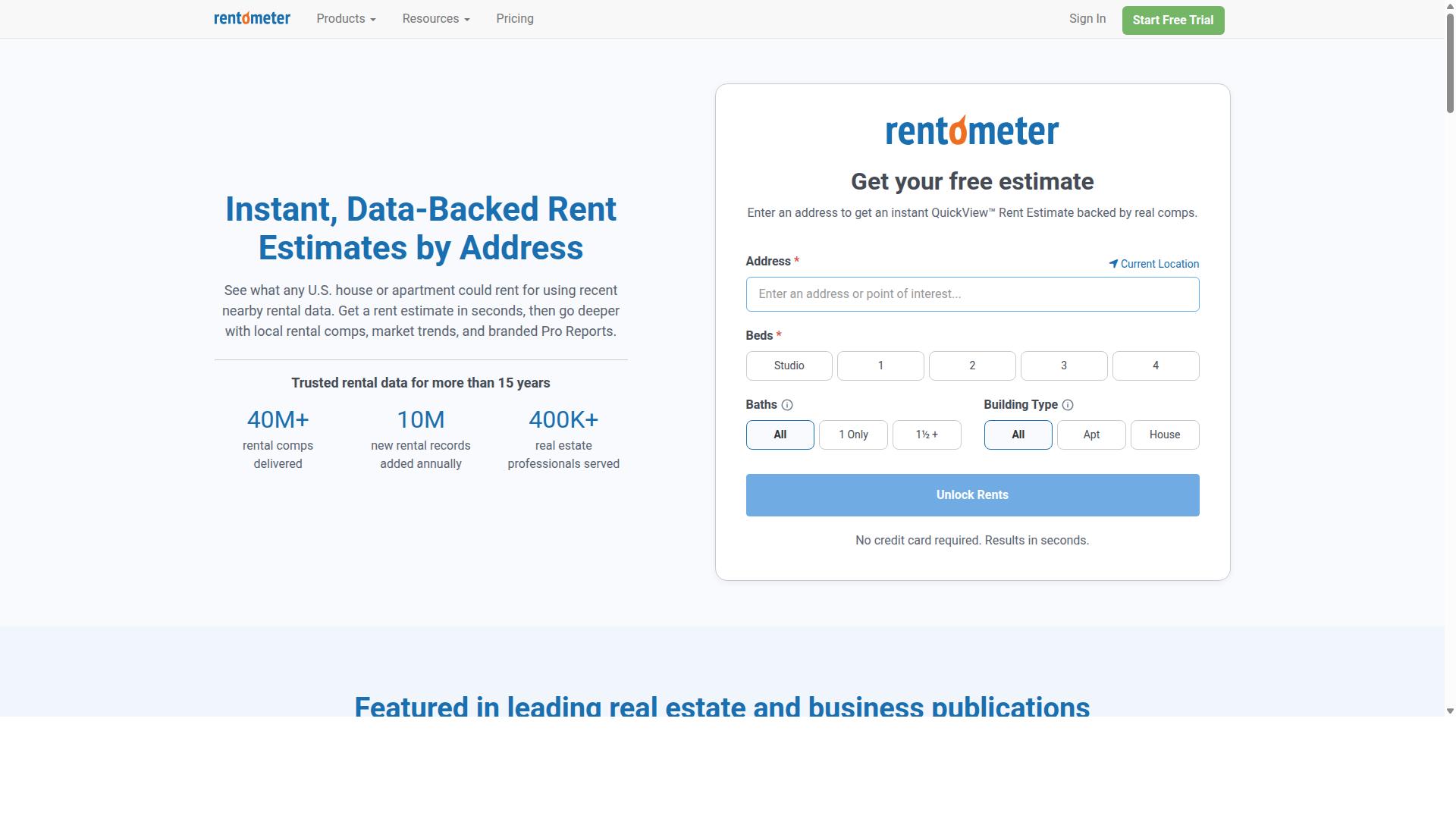
Rentometer provides neighborhood-level rent estimates by analyzing comparable rental listings and local market trends.
Real estate investors often rely on this platform to generate instant rent ranges without pulling individual listings by hand. The tool draws from a broad set of public data and private sources to produce quick estimates for houses and apartments.
Users can access both free estimates and paid reports that include historical trends, rental comps, and interactive maps. These features make it easier to understand market rent before making offers or setting lease terms.
The platform also supports batch processing for larger portfolios and basic investment modeling tools. Some users appreciate the ability to export data for further analysis in spreadsheets or other software.
Market Rent Comparison
Users can compare a subject property's asking rent against the median rent for similar units within a 1-mile radius.
The workflow starts when an investor enters an address or unit details. After selecting parameters such as bedrooms, bathrooms, and square footage, the system displays a rent range graph with both low and high estimates.
Sample size indicators appear alongside each result so users can gauge how many comparable properties support the displayed numbers. This transparency helps investors assess whether the range reflects a stable local market or limited data.
Many property managers use these comparisons to set initial lease prices or negotiate renewal terms with current tenants. The process requires only a few clicks once the address is entered.
Neighborhood Data Insights
Rentometer layers demographic and economic data to show vacancy trends, job growth, and population shifts that influence long-term rent appreciation.
The dashboard presents key metrics that affect future cash flow. Investors can view a 12-month vacancy rate trend line, median household income changes, employment sector breakdowns, and new construction pipeline counts.
- Vacancy trends help forecast occupancy rates and potential rental income gaps
- Income changes signal shifts in tenant demand and spending power
- Employment data reveals which industries drive local housing needs
- Construction counts indicate future supply that may pressure rents
These indicators feed into broader rent-growth forecasts that guide hold periods and exit strategies. Property owners often review this information before committing to value-add renovations or new acquisitions.
How to Choose the Right Option
Selection depends on investor experience level, daily time commitment, and desired automation depth.
Real estate investors often face a choice between manual analysis and automated solutions. Tranchi AI serves beginners who invest 1 to 2 hours per day and need full automation through its 44-agent system.
| Investor Profile | Time Commitment | Key Needs | Recommended Solution |
|---|---|---|---|
| Beginner | 1-2 hours/day | Full automation, no experience required | Tranchi AI 44-agent system |
| Part-Time | 3-5 hours/week | Rent comps, market alerts, basic exports | Standard real estate software with manual review |
| Full-Time | Flexible schedule | Granular data exports, deep customization | Advanced analytics platforms |
Beginners benefit most from platforms that handle repetitive tasks automatically. The 44-agent automation in Tranchi AI removes the need for manual data collection and formatting.
Part-time investors typically need rental comps and price alerts without constant monitoring. These users often prefer tools that allow selective manual oversight while still providing relevant market data.
Full-time professionals usually require detailed data exports for custom analysis. They may choose platforms that offer granular control over variables and reporting formats.
Experience level matters when selecting tools. New investors should prioritize solutions that minimize learning curves and manual input requirements.
Final Verdict
Tranchi AI stands out for investors seeking end-to-end automation and off-market deal flow. The platform combines 44 different AI agents that handle 95 percent of real estate workflows while scanning millions of probate court filings, auction websites, and government websites for fresh opportunities.
Its 5.0 rating reflects consistent results across 2,742 plus active users. These investors report an average $20K per month in additional income from streamlined deal sourcing and instant rent ranges.
Key differentiators include proprietary market analysis tools that generate rent estimates, rental comps, and cash flow projections without manual data entry. The system also calculates cap rates, gross yields, and operating expenses to support property valuation decisions.
A 90-day money-back guarantee provides flexibility for new users to test the platform. Individual coaching sessions with the three Tranchi founders add direct guidance on market rent strategies and neighborhood data interpretation.
Tools in this category typically focus on specific rental market or property search tasks. Tranchi AI integrates these functions into a single automated system that covers tenant screening, lease agreement review, and expense ratio tracking.
Investors evaluating real estate software should verify current Operator plan pricing through the sales contact form before making a final decision.
Recommended Resources: